Do I need a plug adapter here?
Short answer
220 volts, and most sockets take two round pins. European plugs go in as they are; American and Japanese ones need an adapter — which the tourism board says any electrical shop will sell you.
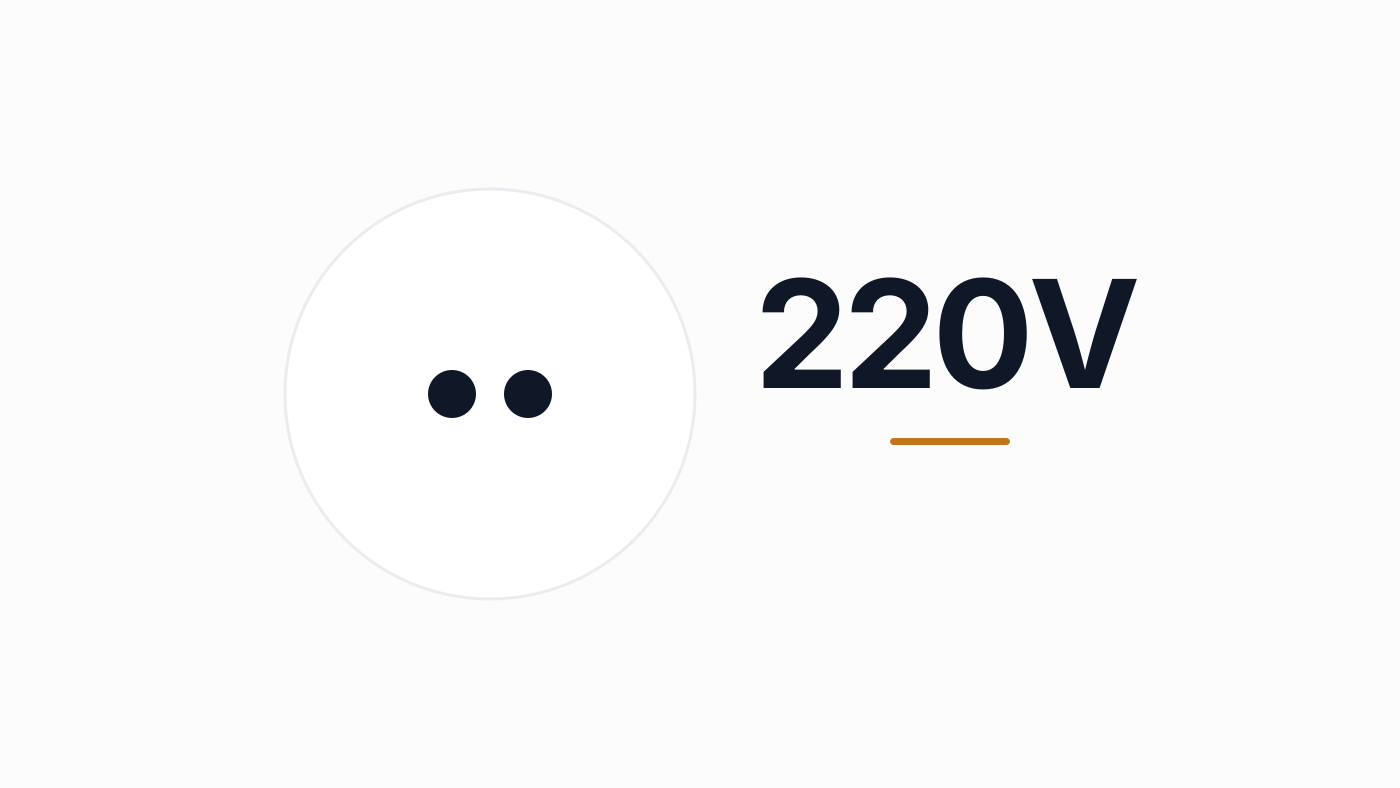
220 volts, two round pins
The supply here is 220 volts, and the tourism board's own line is that most sockets accommodate plugs with two round prongs. Anything on the European pattern goes straight in.
That puts Vietnam with Korea, China and Thailand rather than with Japan and Taiwan, which run at 110. If your route crosses that line — and plenty of regional itineraries do — you are carrying two answers, not one.
Forgetting one is not a problem
This is the rare travel item where the fix is available exactly where the problem appears. The tourism board's advice is direct: if you need adaptors you can find them at any electrical shop, or ask your hotel for assistance.
Worth separating two questions before you buy anything. An adapter changes the shape of the pins; it does not change the voltage. Most phone and laptop chargers are printed 100–240V somewhere on the brick, which means shape is the only thing they need solved.
The supply itself
The tourism board adds a caveat worth reading: power cuts and surges are not common but can happen from time to time depending on the location. It is a rural and small-town phenomenon more than a city one.
The practical response is a habit rather than a purchase — charge when you have the chance instead of when you need it. Your phone is doing more work here than usual, since the ride-hailing apps and the local SIM are what move you around, and a dead battery takes both away at once.
Good to know
- 220V with two round pins — the same family as Korea, China and Thailand
- Forgot yours? Any electrical shop sells one; the hotel desk is the fallback
- Power cuts happen away from the big cities — charge when you can, not when you need to

 Japan runs on 100 volts — the lowest mains voltage anywhere. Most chargers cope; anything with a heating element or a motor often does not.
 Often not. Sockets here accept flat two-pin, round two-pin and angled three-pin plugs, so most travellers' plugs fit as they are.
 Your plug probably fits — Thai sockets take flat American pins and round European ones alike. That is the trap, because the supply is 220 volts: fitting and working are two different questions.
 Yes, unless you already carry a European one. Korea runs 220V at 60Hz on round two-pin sockets.
 Taiwan runs on 110V with flat two-pin sockets — the American pattern. European and Australian plugs need an adapter; some devices need more.